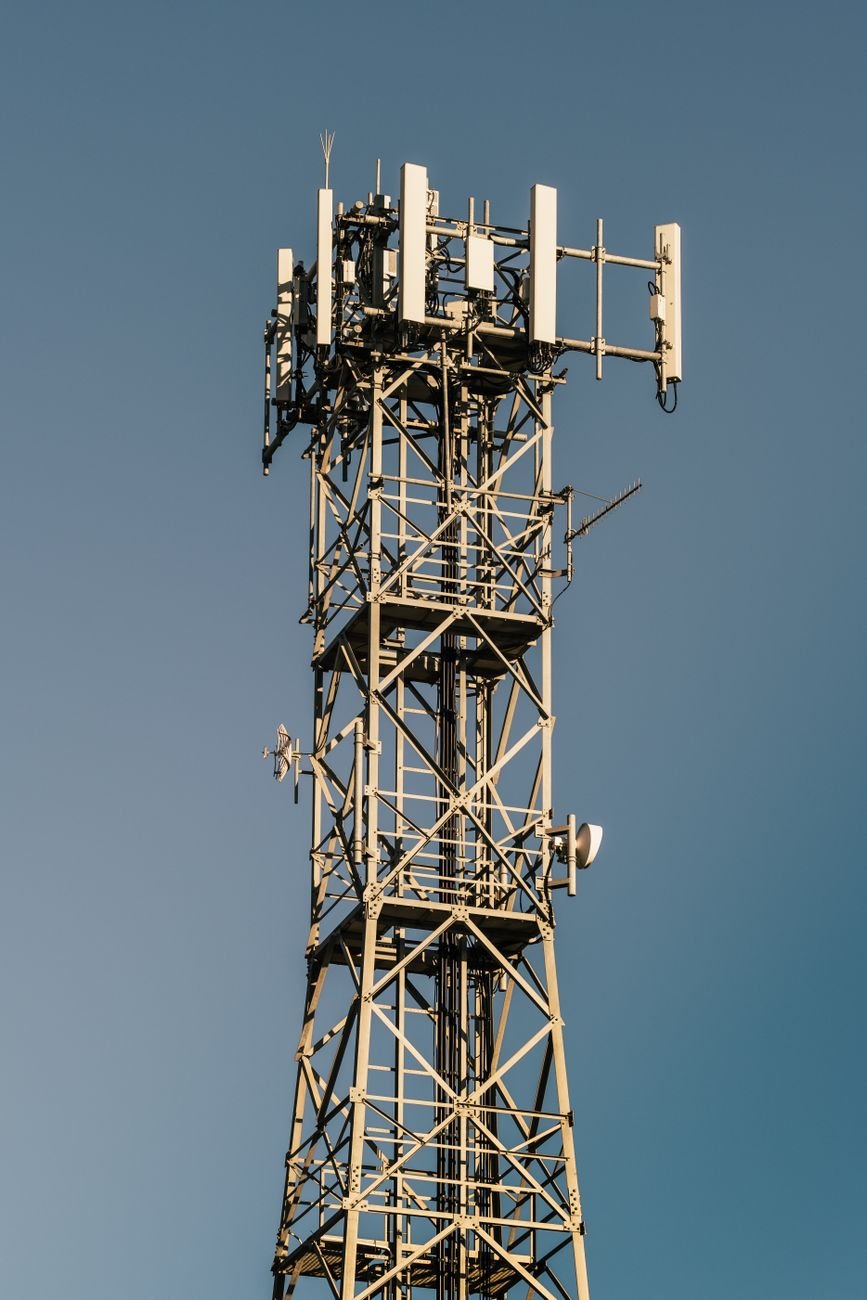
There is now a mobile phone tower in the middle of Murwillumbah. It carries both 4G and 5G, and it has been put up on the corner of Brisbane Street and Proudfoots Lane, near the Australia Post office, in the heart of the town centre. Not on the edge of town. Not out on an industrial lot. In the centre, surrounded by the shops, cafes, offices, churches and services that people use every single day.
A lot of people around town are not happy about it, and this article lays out why, starting with the simple facts of where it is and what it emits.
Exactly where it is
The tower is registered on the Radio Frequency National Site Archive, the national database of mobile sites, as site number 2484003. It stands on the corner of Brisbane Street and Proudfoots Lane, near the post office in the middle of the Murwillumbah town centre. The map below shows the location so you can see for yourself how central it is and what surrounds it.
What surrounds it
The location is the whole point. This is one of the busiest, most populated parts of Murwillumbah, and the tower is right in the middle of it. Within metres and a short walk you have:
Shops and workers
The Main Street and Wollumbin Street retail strip, full of shops, cafes, banks and offices. The people who work in them are there five or six days a week, all day, right next to the tower.
A school nearby
Mount St Patrick College and Mount St Patrick Primary are close to the town centre. Children spend their days learning a short distance from the transmitter.
Churches and a medical centre
Places of worship and the Main Street medical centre sit in the same central pocket, used by families, the elderly and the unwell.
Residents and passers-by
People live in and around the CBD, and thousands more pass through it every week. The tower is in the path of daily life, not tucked away from it.
It runs all day, and you cannot turn it off
A mobile tower is not like a phone you put down or a wifi router you unplug at night. It transmits continuously, 24 hours a day, seven days a week. Everyone within range is exposed the entire time they are nearby. For a shop worker on Main Street, that is their whole working week. For a child at a nearby school, it is every school day. For someone who lives in the centre of town, it is around the clock. Nobody in the vicinity gets a choice about it, and nobody can switch it off.
The exposure is strongest closest to the tower and falls away with distance. That is exactly why putting it in the middle of town, rather than well away from where people spend their days, is what has upset so many locals. The people who carry the most of it are the ones who work, learn, worship and live closest to it.
This radiation is officially classed as a possible carcinogen
The energy a mobile tower emits is radiofrequency electromagnetic radiation. In 2011 the World Health Organization's own cancer research agency, IARC, classified radiofrequency electromagnetic fields as a possible carcinogen, in the category known as Group 2B. That is not a fringe claim or a rumour. It is the formal position of the WHO's cancer body, and it still stands today.
On top of that, the higher frequencies used by 5G are relatively new, and there is no long-term evidence showing that continuous, lifelong exposure to them is safe. These bands simply have not been in widespread public use long enough for anyone to know what decades of round-the-clock exposure does. Rolling that out in the middle of a town, next to a school, and asking people to assume it is fine, is asking them to take that on trust.
The "safety limit" does not settle it. Carriers point to compliance with the ARPANSA exposure limit. That limit is built mainly around how much the radiation heats human tissue over short periods. It was never designed to rule out the effects of low-level, non-heating exposure that continues every hour of every day for years. Being "within the limit" is a statement about heating, not a clean bill of health.
Why people are unhappy, and why it is reasonable
Murwillumbah and the wider Tweed is a community that pays close attention to health, to what goes into people's bodies and into the environment. So when a transmitter that emits a classified possible carcinogen appears in the middle of town, next to where children learn and where people work all day, without the community being properly asked, it is no surprise that a lot of residents are angry.
The reasonable response to something that is a possible carcinogen, that runs continuously, and whose long-term effects are unproven, is caution, especially about where you put it. Keeping infrastructure like this away from schools, workplaces and the busiest part of town is not paranoia. It is the sensible, precautionary thing to do, and it is what many locals believe should have happened here.
| The facts | Detail |
|---|---|
| What it is | A 4G and 5G mobile tower, RFNSA site 2484003 |
| Where | Centre of Murwillumbah, corner of Brisbane Street and Proudfoots Lane, near the post office |
| Nearest school | Mount St Patrick College and Primary, a short distance away |
| Also close by | Shops and workplaces, churches, the Main Street medical centre, homes |
| When it emits | Continuously, 24 hours a day, every day |
| Radiation classification | WHO/IARC Group 2B, possibly carcinogenic to humans (2011) |
How to check it and raise your concerns
If you want the official details of the tower, the RFNSA listing for site 2484003 has the address, the carriers, the antenna heights and the frequency bands. If you want to object, ask about consultation, or find out what say the community was given, contact Tweed Shire Council and the carrier named on the RFNSA page. Local channels such as the Tweed Valley Weekly and the town's community Facebook groups are where notices and the local conversation tend to appear first, so they are worth watching and worth adding your voice to.
If you are new to town and getting your bearings, our guide to moving to Murwillumbah covers the essentials, and you can always browse the local directory for the shops and services around the town centre.